Mutuelle de Santé vs RSSB: What's the Difference for Pharmacy Billing?
Mutuelle covers 90%. RSSB covers 85%. Different receipts, different claim channels, different rules. Everything Rwanda pharmacies need to know about both schemes.

If you run a pharmacy in Rwanda, you have probably noticed that not all insurance cards look the same. Some patients come with a green RSSB card. Others bring a Mutuelle de Santé booklet. A few carry both.
Both schemes help patients pay for medicines but the way billing works is different. If you mix them up at the counter, you will charge the wrong amount, print the wrong receipt, and create problems when the insurer reviews your claims.
This article explains the difference in plain language.
What Is Mutuelle de Santé?
Mutuelle de Santé, often called simply Mutuelle, is Rwanda's community-based health insurance scheme. It is run by the Ministry of Health and managed at the district level.
It was created to cover Rwandans who are not in formal employment: farmers, small traders, people working in the informal sector, and their families.
Key facts:
- Membership is per household, renewed every year
- Premiums are based on income category (Ubudehe classification)
- Covers consultations, hospitalisation, and medicines on the approved list
- The patient pays a co-payment of 10% of the bill at the pharmacy
- The scheme covers the remaining 90%
Mutuelle is the most widely used insurance scheme in Rwanda. Millions of Rwandans carry a Mutuelle card.
What Is RSSB?
RSSB stands for Rwanda Social Security Board. It is a government institution that manages social security for Rwanda's formal workforce civil servants, employees of registered companies, teachers, military, and their dependants.
RSSB has two health insurance branches that pharmacies commonly deal with:
- RSSB-MMI (formerly known as the Military Medical Insurance) covers Rwanda Defence Force members and their families
- RSSB-RAMA (Rwanda Medical Insurance) covers civil servants and employees of organisations affiliated with RSSB
Key facts:
- Membership comes automatically with formal employment
- The employer and employee both contribute monthly
- Coverage rates depend on the scheme, but the most common split is 85% insurer / 15% patient
- Only medicines on the RSSB formulary (approved drug list) are covered
- The pharmacy submits a claim to RSSB after dispensing; payment comes later
Side-by-Side Comparison
Why the Difference Matters at Your Counter
1. The split amount is different
With Mutuelle, the patient pays 10% of the total. With RSSB, the patient pays 15%. If your pharmacy management system is not set up correctly for each scheme, you will either overcharge or undercharge the patient and under-claim from the insurer.
Example: A patient buys medicines totalling RWF 6,208.
That is a difference of over RWF 310 on one invoice. Multiply that by dozens of patients per day and it becomes a serious financial gap.
2. The receipt format is different
RSSB requires a specific document called Facture des Médicaments (Medicine Invoice). This invoice must show:
- The patient's RSSB membership number (Beneficial N°)
- The affiliate name (head of family on the account)
- The relationship (self, spouse, child)
- The prescribing doctor or hospital (HSP)
- Each medicine with batch number, expiry date, quantity, unit price
- A clear split showing the patient's 15% and RSSB's 85%
- SDC/EBM data (receipt signature, MRC code, SDC ID)
Mutuelle uses a simpler co-payment receipt. You collect the 10%, stamp the patient's booklet or card, and the district office handles reimbursement separately.
If you print an RSSB-style invoice for a Mutuelle patient or vice versa, the insurer will reject your claim.
3. The claim submission process is different
Mutuelle: The pharmacy submits claims to the local district health office, usually monthly. The paperwork and approval process is managed at district level.
RSSB: The pharmacy builds a claim file one Facture des Médicaments per patient per visit and submits to RSSB. RSSB reviews and pays in bulk. The open amount sits as a receivable until RSSB pays.
Your pharmacy management system needs to track RSSB claims separately from Mutuelle reimbursements, because they move through completely different channels.
What About Patients With Both Cards?
It is possible for a civil servant who is also a Mutuelle member to carry both cards though this is rare in practice. When it happens, the standard rule is to use the primary scheme (RSSB) first. Mutuelle is typically not used as a top-up for RSSB co-payments.
If in doubt, check with the patient which card they want to use for this visit and record it clearly on the invoice.
Common Mistakes to Avoid
Applying the wrong coverage rate. Always confirm which scheme the card belongs to before applying a split. A green RSSB card and a Mutuelle booklet look very different but in a busy pharmacy, it is easy to make a mistake if your system does not guide the cashier.
Forgetting the HSP field. RSSB invoices require the name of the prescribing doctor or hospital. If it is missing, RSSB may reject the claim. Train your staff to always ask for the prescription and record the doctor's name.
Selling a product not on the formulary. If a medicine is not on the RSSB formulary, RSSB will not reimburse it, the patient must pay 100%. Your system should flag this automatically so the cashier can inform the patient before finalising the sale.
Not printing the right receipt. Keep the RSSB Facture des Médicaments and the standard Mutuelle receipt as separate document types. Print the correct one every time, and keep a copy in your records for claim submission.
How Rexolia Handles This
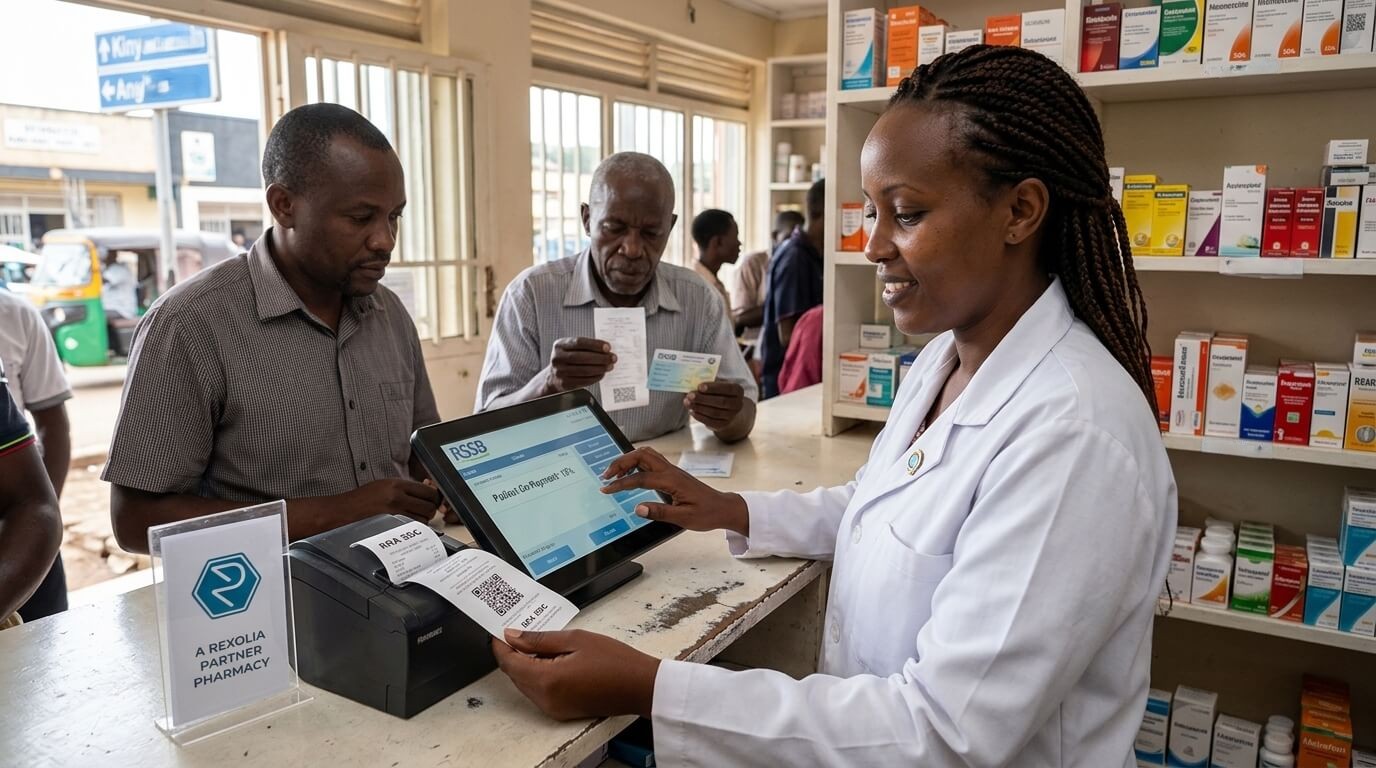
Rexolia pharmacy management treats Mutuelle and RSSB as separate insurance partners, each with their own coverage rate and formulary.
When a patient presents their card:
- The system identifies the scheme automatically from the card linked to their profile
- Every item in the cart shows the split instantly patient portion and insurer portion
- At checkout, the cashier only collects the patient's share
- The system generates the correct receipt format for the scheme
- Open RSSB claims are tracked as receivables until RSSB pays
No manual calculation. No wrong receipt. No rejected claims from a missing HSP or wrong percentage.
Summary
Both schemes are a good thing for your pharmacy. They bring in more patients who can afford treatment. But they only benefit you if your billing is correct from the first sale to the final payment from the insurer.
Running a pharmacy in Rwanda? Rexolia is built for exactly this. RSSB billing, Mutuelle co-payments, RRA EBM compliance, and full stock management in one platform. Start your free tria