The True Cost of Shopify Transaction Fees (And How Third-Party Gateways Eat Your Margins)
Unpack how payment gateway penalties, third-party processing markups, and currency conversion fees silently drain e-commerce profit margins. Learn the true math behind platform processing fees and see how switching to a unified business engine protects your revenue and cash flow as you scale.
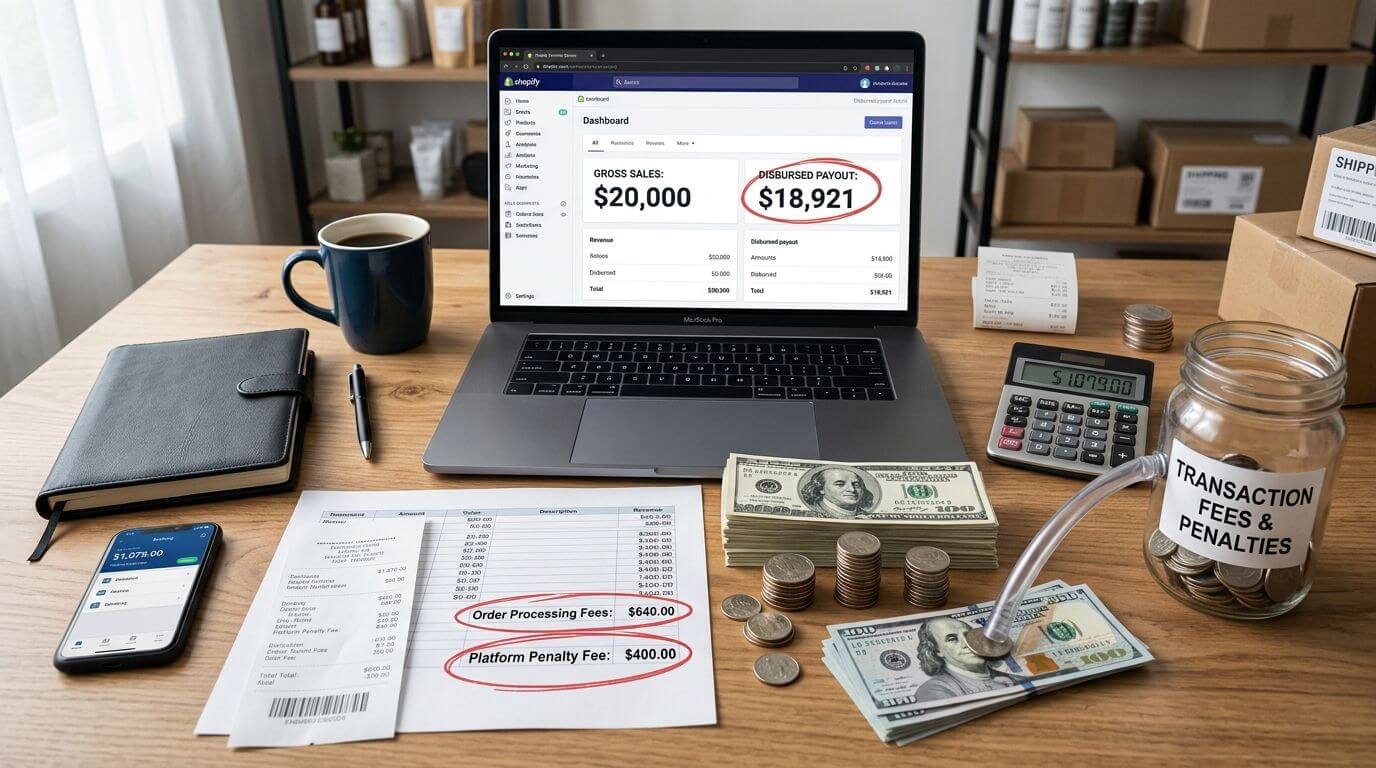
When you build a business, the math seems simple at first: build a great product, set up your store, pick a standard subscription plan say, Shopify Basic at around $39/month, and scale up. You calculate your cost of goods, factor in ad spend, and project healthy gross margins.
Then the orders start rolling in. But when end-of-month financial reconciliation hits and you check your actual bank payouts, the numbers rarely match your expectations. Your gross profit margin looks strangely compressed.
Where is that missing profit going? The answer lies in the fine print of platform fee structures: payment gateway penalties, mandatory platform cuts, and hidden currency surcharges. For founders scaling toward 6- and 7-figure revenues on tight margins, these operational fees quietly siphon off 3% to 6% of gross turnover.
Unpacking the Two-Tiered Payment Tax
To understand why your payouts don't match your ledger, you must distinguish between two fundamentally different types of fees on every sale:
· 1. Merchant Processing Fees: The underlying operational cost charged by financial networks (Visa, Mastercard, Amex, PayPal) to clear funds from a buyer's account to yours.
· 2. Platform Transaction Penalties: An extra fee charged directly by the e-commerce platform simply because you chose not to use their in-house payment processor.
|
THE DUAL-FEE IMPACT |
If you use Shopify’s default processor (Shopify Payments), they waive the extra platform transaction penalty. But the moment your business requires an external payment gateway whether for better fraud prevention, international checkout options, or industry compliance Shopify levies a direct penalty tax on every single transaction:
· Basic Plan: +2.0% extra penalty per transaction
· Grow Plan: +1.0% extra penalty per transaction
· Advanced Plan: +0.6% extra penalty per transaction
The Real-World Math: Siphoning Growth Capital
Let's look at what this fee structure actually costs an ambitious founder processing $20,000 per month in sales on the Basic Plan, using an external gateway like PayPal or direct Stripe processing.
|
Fee Category |
Calculation |
Monthly Cost |
|
External Gateway Fee (2.9% + $0.30) |
$20,000 × 2.9% + approx fixed fees |
$640.00 |
|
Shopify Platform Penalty (2.0%) |
$20,000 × 2.0% (Platform Tax) |
$400.00 |
|
Base Software Subscription |
Fixed Monthly Basic Plan |
$39.00 |
|
Total Monthly Operating Software/Fee |
Gateway + Penalty + Subscription |
$1,079.00 |
Notice the key takeaway:
|
THE HIDDEN BOTTOM-LINE LOSS |
Why Growing Merchants Get Trapped in Dual Fees
If platform penalties are so aggressive, why don't all business owners just stay on the default built-in processor?
Because real-world business growth demands operational flexibility that standard default payment gateways rarely accommodate:
· 1. Regional & Cross-Border Expansion: Built-in gateways are unavailable in dozens of countries, forcing international founders into mandatory penalty rates.
· 2. Specialized Verticals: High-ticket items, subscription services, B2B hardware, or niche goods often require custom merchant providers with tailored risk models.
· 3. Preferred Customer Payment Methods: Converting shoppers in markets like Europe or Asia requires offering local payment options (Klarna, iDEAL, direct bank transfers, or cash-on-delivery).
· 4. B2B Wholesale & Custom Terms: B2B buyers operate on invoice terms (Net-30/60) and credit lines, which standard B2C checkout gateways cannot support natively.
When your platform penalizes you for implementing the financial workflows your business actually needs, your software vendor has shifted from an enabler to a bottleneck.
The Hidden Fee Stack: Compounding Costs Beyond Transactions
Platform penalties are only the most visible fee. When using modular e-commerce apps that lack integrated business engines, costs stack up across multiple fronts:
· • Currency Conversion Surcharges: Cross-border sales processed through standard platform gateways routinely carry an additional 1.5% to 2.0% conversion mark-up.
· • International Card Processing Bumps: Transactions completed with international customer cards trigger automatic +1.0% processing surcharges.
· • Third-Party App Subscription Creep: Because basic store builders lack built-in inventory management, invoicing, and POS sync, merchants spend an additional $150 - $500/month on third-party marketplace apps just to keep operational data in sync.
The Alternative: Platform Freedom with Unified Operations
As an entrepreneur, you shouldn't have to choose between functional operational tools and healthy profit margins.
At Rexolia was built on a simple premise: your business software should empower your operational freedom, not tax your growth.
|
THE REXOLIA UNIFIED ADVANTAGE |
Take Control of Your Effective Processing Rate
Before renewing your current platform software or accepting another fee hike, run an audit on your total software and processing fees over the last 90 days. Calculate your true effective processing rate by dividing your total payment and software costs by your gross revenue.
If platform penalties and app subscriptions are eating into your growth margin, it is time to upgrade to an operational architecture built for modern business freedom.
Take Action: Ready to eliminate unnecessary platform fees and unify your store operations?
Explore Rexolia today and calculate how much profit you retain when your software works for you not against you. One button migration of your products and history.