Rexolia vs Shopify: The Honest Comparison for Business Owners Tired of Hidden Costs
We compare Rexolia and Shopify feature by feature, storefront setup, inventory, POS, CRM, and true monthly cost. One platform includes everything. The other needs apps, subscriptions, and a developer. Here's the honest breakdown for business owners who want to sell, not manage software.
If you're researching "Rexolia vs Shopify," you're probably doing one of two things:
-
Launching your first online store and wondering if Shopify is still the default choice it used to be.
-
Already on Shopify and quietly adding up your monthly app bills, transaction fees, and the hours you spend syncing inventory between your online store, POS, and spreadsheets.
This guide is for both of you.
We built Rexolia after watching small business owners assemble fragile tech stacks just to sell products online. Shopify is powerful. But "powerful" and "right for you" are not the same thing.
Below is a feature-by-feature breakdown, a true-cost comparison, and the real-world scenarios where Rexolia wins and where Shopify still makes sense.
The Core Difference: All-in-One vs. Assembly Required
| Rexolia | Shopify | |
|---|---|---|
| Philosophy | One complete platform. Everything built-in. | Best-in-class ecommerce core. Everything else via apps. |
| Storefront setup | Minutes with ready-made templates | Hours to days (theme selection, customization, app installs) |
| Inventory | Built-in, real-time, multi-channel | Basic. Advanced features require apps. |
| POS | Native, included | Shopify POS ($89/month) |
| CRM & Email | Built-in | Requires Klaviyo, Mailchimp, or similar |
| Analytics | Built-in dashboard | Basic. Advanced reports require higher plans or apps. |
| Multi-channel sync | Native (Shopify, WooCommerce, TikTok, Instagram, Etsy, POS) | Native for some channels; inventory sync often requires apps |
| Apps needed to run a real business | Zero | 3 - 10 |
| True monthly cost | One flat price | Base plan + apps + transaction fees |
Shopify is a platform. Rexolia is a business operating system.
Shopify's superpower is its app ecosystem. If you need hyper-specific functionality, there's probably an app for it. But that superpower becomes a liability when you're a solopreneur or small team managing five different subscriptions just to handle inventory, email, and in-store sales.
Rexolia's bet is different: most businesses don't need 8,000 apps. They need one system that actually works out of the box.
Feature-by-Feature Breakdown
1. Launching Your Store
Shopify: You choose a theme (free or paid, $0 - $350), customize it, install essential apps, configure payments, set up shipping, and then if nothing breaks, go live. For non-technical users, this takes days. For technical users, it still takes hours.
Rexolia: You pick a template from a growing library of professionally designed storefronts. Add your logo, colors, and products. Go live in minutes. The templates are ready for retail, services, subscriptions, and hospitality not just generic ecommerce.
Winner: Rexolia for speed and simplicity. Shopify for infinite customization (if you have a developer).
2. Inventory Management
Shopify: Shopify tracks inventory, but the moment you sell in multiple places online, in-store, on Instagram, on TikTok, you hit a wall. Shopify's native inventory doesn't automatically sync with external channels in real time. You need apps like StockSync, Katana, or a custom integration. Or, more commonly, you end up in spreadsheets.
Rexolia: Inventory is the backbone of the platform, not an afterthought. Your stock count is one live source of truth connected to your storefront, your POS, and any external channels you choose to sync. Sell a unit in-store? Your online stock updates instantly. Get an order on TikTok? Your warehouse count reflects it immediately.
Winner: Rexolia, by a wide margin, for anyone selling on more than one channel.
3. Point of Sale (POS)
Shopify: Shopify POS exists, but it's a separate product. On most plans, you pay extra for it. If you want advanced features like staff management or analytics, you need Shopify POS Pro at $89/month per location.
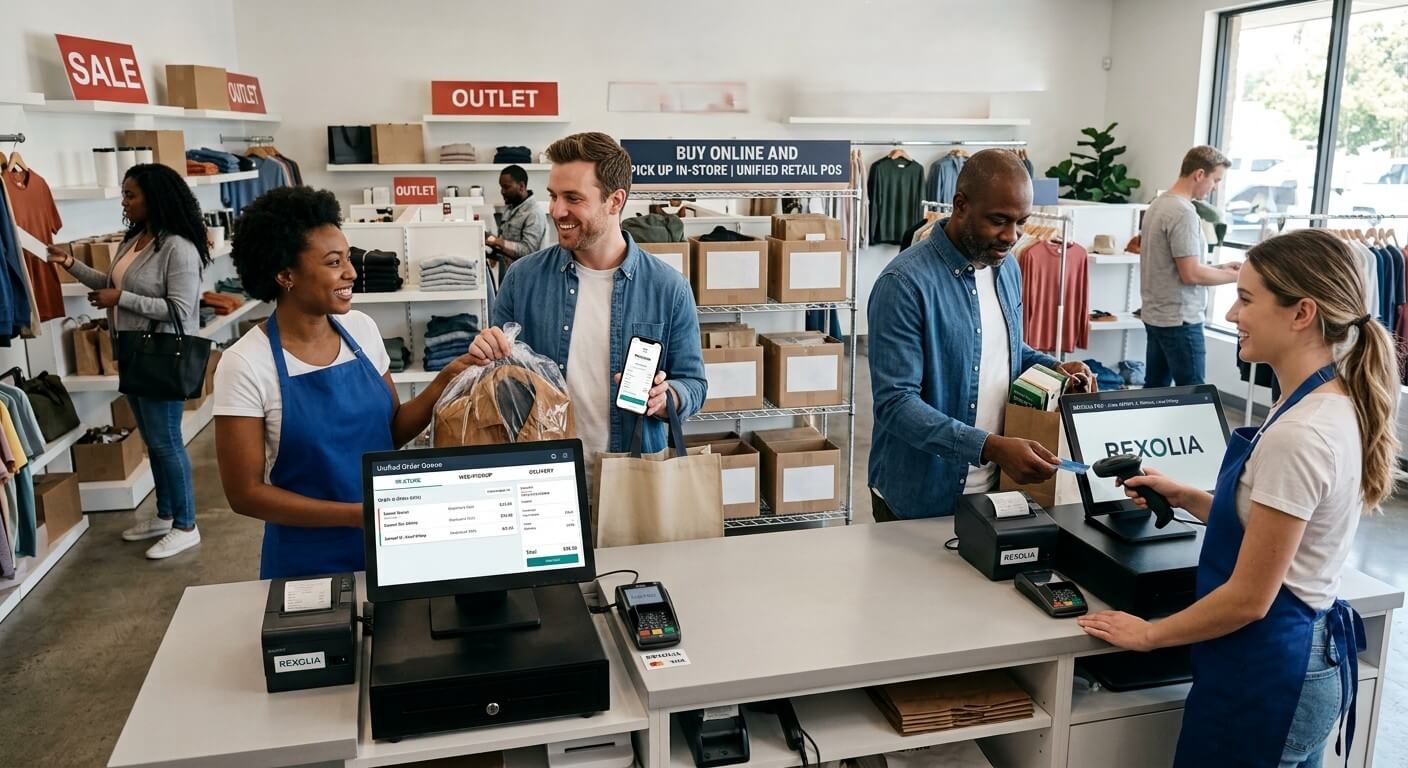
Rexolia: POS is native and included. Your in-store sales, online orders, and inventory all live in one system. No separate login, no separate bill, no sync lag between your physical shop and your website.
Winner: Rexolia for retailers with both online and offline presence.
4. CRM, Email & Customer Management
Shopify: Shopify collects customer data at checkout, but anything beyond basic order history requires an app. Want automated email flows? That's Klaviyo ($20–$100+/month). Want a customer support helpdesk? Another app. Want to track lifetime value? Export to a spreadsheet or buy another tool.
Rexolia: Customer profiles, order history, communication logs, and automated invoicing are built into the same dashboard where you manage your store. You see the full customer journey, from first visit to repeat purchase, without exporting data to a third party.
Winner: Rexolia for businesses that care about customer relationships, not just transactions.
5. Multi-Channel Selling
Shopify: Shopify plays well with Facebook, Instagram, and TikTok, but primarily as sales channels that push your Shopify catalog out. If you also have a WooCommerce store, an Etsy shop, or a separate POS system, keeping inventory aligned is your problem. You'll need middleware apps or manual reconciliation.
Rexolia: Built for sellers who already exist everywhere. Connect Shopify, WooCommerce, Etsy, TikTok Shop, Instagram, and your POS. Rexolia becomes your central hub. You can manage everything from one dashboard or gradually migrate channels onto your native Rexolia storefront.
Winner: Rexolia for multi-channel sellers. Shopify for single-channel simplicity.
6. Pricing: The True Cost
This is where Shopify's $39/month Basic plan becomes a mirage.
Shopify's Real Monthly Cost (for a typical small retailer):
| Item | Cost |
|---|---|
| Shopify Basic | $39/month |
| Shopify POS Pro (1 location) | $89/month |
| Inventory sync app | $15 - $50/month |
| Email marketing app | $20 - $100/month |
| Advanced analytics app | $10 - $30/month |
| Theme (amortized) | $10 - $30/month |
| Transaction fees (if not using Shopify Payments) | 0.5 - 2% per sale |
| True monthly cost | $200 - $400+/month + transaction fees |
Rexolia's Cost:
| Item | Cost |
|---|---|
| Rexolia plan | One flat price |
| POS | Included in Suite plan |
| Inventory sync | Included in Suite plan |
| Email/CRM | Included always |
| Analytics | Included |
| Transaction fees | None |
| True monthly cost | One predictable price |
Shopify's business model is brilliant: acquire customers at $39, then monetize them through apps and transaction fees. It works for Shopify. It's expensive for you.
7. Customization & Scalability
Shopify: If you have a developer and a unique business model, Shopify's Liquid templating and app ecosystem let you build almost anything. Enterprise brands with complex needs often choose Shopify Plus.
Rexolia: Designed for small to medium businesses that want enterprise-grade features without enterprise complexity. The trade-off is less granular customization than Shopify's open ecosystem. If you need to build a completely custom checkout flow or a bespoke B2B portal, Shopify is more flexible.
Winner: Shopify for enterprises with dev teams. Rexolia for business owners who want to sell, not code.
Who Should Choose Rexolia?
-
New online sellers who want to launch today without learning a tech stack
-
Retailers with physical stores who need POS and online inventory to stay in sync
-
Multi-channel sellers on Shopify, WooCommerce, Etsy, TikTok, and Instagram who want one dashboard
-
Solopreneurs and small teams who can't afford $200+/month in app subscriptions
-
Business owners in emerging markets who need local payment methods, tax compliance, and support that understands their context
Who Should Choose Shopify?
-
High-volume enterprises with dedicated developers and custom requirements
-
Merchants who need a specific app that only exists on Shopify's ecosystem
-
Brands that prioritize maximum design flexibility over operational simplicity
-
Businesses already deeply embedded in the Shopify ecosystem with no pain points
The Migration Question: How Hard Is It to Switch?
If you're already on Shopify, switching sounds daunting. It's not.
Rexolia can import your Shopify product catalog, customer list, and order history directly. Your existing Shopify store can stay live while you set up your Rexolia storefront. Once you're ready, connect the two for real-time inventory sync or gradually shift traffic to your new Rexolia store.
You don't need to rip the band-aid off. You can phase the migration.
Real-World Scenario: A Month in the Life
Sarah runs a boutique in Kigali and sells on Instagram and Shopify.
With Shopify:
-
She pays $39 for Shopify Basic, $89 for POS Pro, $25 for an inventory app, and $30 for an email app. That's $183 before her first sale.
-
She sells a dress in-store. She manually updates her Shopify inventory. She forgets once. A customer orders it online. She refunds the order, loses the sale, and apologizes.
-
She spends 2 hours every Sunday reconciling stock between her shop, her website, and her Instagram DMs.
With Rexolia:
-
She launches her Rexolia store in 45 minutes using a retail template.
-
She connects her existing Shopify and Instagram channels. Inventory syncs automatically.
-
She sells a dress in-store. Her online stock updates instantly. No overselling.
-
She checks one dashboard to see what's selling where, who her best customers are, and what to reorder.
-
She pays one flat price. No app bills. No transaction fees.
Final Verdict
Shopify is a great ecommerce platform. Rexolia is a great business platform that happens to include ecommerce.
If your goal is to build a custom, app-heavy, developer-dependent store, Shopify is hard to beat.
If your goal is to sell products, manage inventory, serve customers, and run your business without managing a subscription stack, Rexolia is the better choice.
Ready to See the Difference?
Launch your Rexolia storefront free. No credit card. No app store. No surprises.
Rexolia Team
|
08 Jul 2026
Multi-Channel Retail
Retail & POS
E-commerce Strategy